Cleaning & janitorial
Nitrile gloves for commercial cleaning
Everyday and heavier-duty disposable options for janitorial teams, property care, housekeeping and routine workplace sanitation.

Common workflows
Plan glove use around the actual work.
Routine wiping, restroom service, food-area sanitation and chemical preparation need separate change rules and hazard checks.
Routine surface cleaning
For wiping and light housekeeping, prioritize fit, dexterity and an efficient change routine. Check the cleaning-product label even when the task appears familiar.
Restrooms & property turns
Define changes between rooms and zones and keep the real size mix on carts. Dispose of single-use gloves and perform hand hygiene under site procedures.
Food areas & chemicals
Separate cleaning PPE from food-handling gloves. Follow the product label and SDS for dilution, contact time, ventilation and required protection.
Waste, spills & sharps
Unknown spills, bodily fluids and sharp objects need a specific risk assessment. Disposable nitrile is not puncture-proof or universal chemical protection.
Selection guide
Build a specification your team can follow.
A useful glove program is specific enough for employees and purchasing teams to repeat. Start with four decisions, then confirm the safety boundary for each substance and task.
Thickness
Routine high-change cleaning may favor 5–6 mil; longer or more abrasive work may justify 7–10 mil. The chemical label and SDS—not thickness alone—determine suitability.
Fit & texture
Fit affects grip on bottles, cloths and tools. Texture can help with wet handling, while the chosen cuff length should reflect splash and task requirements.
Color & process control
Color coding can separate restroom, kitchen and general-area tools or teams. The color system should reinforce—never replace—written cleaning procedures.
Pack plan
Estimate by cleaners, rooms, shifts and defined zone changes. Place the right specification on each cart instead of asking one glove to cover every chemical and spill.
Related operating guides
Go deeper into the workflow.
Use these guides to define task boundaries, glove-change points and purchasing inputs before selecting a product.
 Glove guide
Commercial Cleaning Gloves: Change Points and Chemical Boundaries
Glove guide
Commercial Cleaning Gloves: Change Points and Chemical Boundaries
Organize glove changes across rooms, cleaning, disinfection and waste while following labels, SDSs and task-specific chemical requirements.
Read the guide Glove guide
Disposable vs Reusable Cleaning Gloves: Task Guide
Glove guide
Disposable vs Reusable Cleaning Gloves: Task Guide
Choose disposable or reusable cleaning gloves from task duration, splash, immersion, room changes and chemical documentation.
Read the guideRecommended starting points
Compare UYKKE options for the work.
These products are practical starting points—not blanket approvals for an entire industry. Compare fit, thickness, texture, pack format and current availability, then confirm product-specific suitability before use.
Why UYKKE
Factory-direct value, proven in the market.
UYKKE gloves are produced directly with one of China’s leading manufacturers of medical and protective products—without an added trading intermediary—for consistent quality, responsive supply and competitive case pricing.
Manufacturing capability is not a medical-grade or hazard claim for every SKU. Confirm the exact product documentation and task requirements.
-
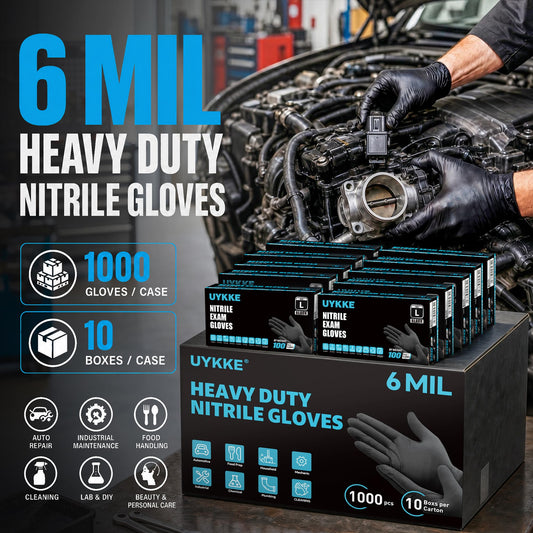
UYKKE 6 Mil Black Nitrile Gloves — 1000 Count
Regular price From $81.96 USDRegular price View on Amazon
-
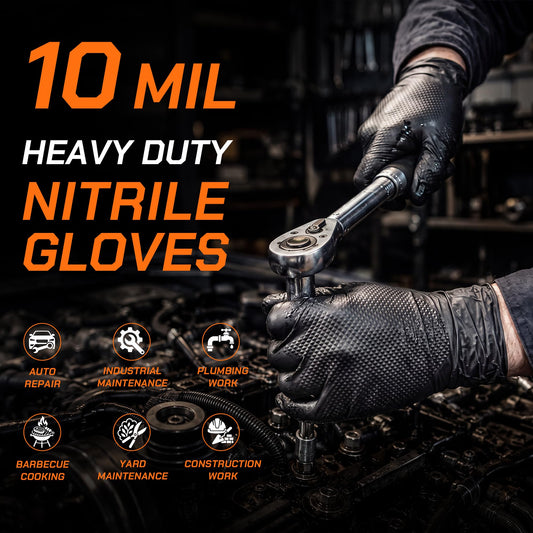
UYKKE 10 Mil Black / Orange Nitrile Gloves — 100 / 1000 Count
Regular price From $23.96 USDRegular price -
UYKKE SuSwel Series 8 Mil Orange Nitrile Gloves — 1000 Count
Regular price From $119.98 USDRegular price





Supply planning
Keep the right glove available at the right station.
Start with a simple monthly baseline: employees per shift × pairs per employee × operating days. Then add task changes, multiple shifts, seasonal peaks and reserve stock. Track usage by size and glove type, not only by total cases.
For cleaning teams, account for rooms, zones, cart routes and chemical tasks. Separate disposable stock used for routine work from reusable or task-specific PPE used for concentrates, sharps or high-contamination cleanup.
Industry FAQ
Practical questions before you standardize a glove
What thickness works for commercial cleaning?
Routine high-change wiping may suit 5–6 mil, while longer or more abrasive work may justify 7–10 mil. Choose after reviewing the task, chemical and observed tear rate—not from thickness alone.
Are nitrile gloves suitable for bleach and disinfectants?
Suitability depends on the formulation, concentration and contact time. Always follow the product label and SDS and use the specified glove material and other PPE.
Should cleaners use the same gloves between rooms?
Define change points by room, zone and contamination level. Changing gloves can help avoid carrying soil between areas, but it must be paired with hand hygiene and the site cleaning procedure.
When are reusable cleaning gloves a better choice?
Prolonged chemical contact, heavy scrubbing, immersion or certain high-contamination tasks may call for reusable chemical gloves with an appropriate cuff and verified compatibility.
Are disposable nitrile gloves puncture-proof?
No. They do not protect reliably from needles, broken glass or other sharps. Use tools and puncture-resistant protection specified by the spill or waste-handling procedure.
Can color coding help janitorial teams?
Yes, when it supports a written system for restrooms, kitchens, guest rooms or general areas. Color does not indicate chemical resistance and cannot replace employee training.