Industrial & maintenance
Nitrile gloves for demanding shop tasks
Compare disposable nitrile gloves for painting, maintenance, equipment work and general industrial handling. The exact task and substances involved should always guide selection.

Common workflows
Plan glove use around the actual work.
Assembly, routine service, coatings and material handling need separate task rules. Treat disposable nitrile as one option within the site PPE program.
Machine inspection
Close fit supports checks, adjustments and small-parts handling around de-energized equipment. Follow lockout procedures and never use disposable gloves as protection from moving machinery.
Assembly & routine service
Dexterity suits assembly and quality checks; texture and added durability can help around lubricated components. Verify compatibility with each fluid used.
Painting, coatings & chemicals
Paint systems, adhesives and cleaners vary widely. Review the SDS and glove compatibility data for the exact formulation and contact time.
Handling & hazard boundaries
Sharp edges, heavy loads, unknown spills and prolonged abrasion may require a reusable cut-, impact- or chemical-rated glove instead.
Selection guide
Build a specification your team can follow.
A useful glove program is specific enough for employees and purchasing teams to repeat. Start with four decisions, then confirm the safety boundary for each substance and task.
Thickness
Match thickness to dexterity, task duration and mechanical wear. Chemical permeation and breakthrough must be evaluated separately for the exact glove and substance.
Fit & texture
Choose texture for wet or oily handling and fit for controls and small parts. Do not wear gloves around moving machinery where entanglement is a hazard.
Color & process control
High-visibility colors can help with compliance checks; dark colors suit dirty work. Keep the protection specification independent from appearance.
Pack plan
Map each glove specification to approved tasks, then forecast by shift and maintenance schedule. Avoid one universal SKU for unrelated chemical and mechanical hazards.
Related operating guides
Go deeper into the workflow.
Use these guides to define task boundaries, glove-change points and purchasing inputs before selecting a product.
 Glove guide
Industrial Maintenance Gloves: A Task-to-Glove Selection Guide
Glove guide
Industrial Maintenance Gloves: A Task-to-Glove Selection Guide
Build a task-to-glove matrix for inspection, assembly, lubrication, coatings and cleanup while keeping mechanical and chemical hazards separate.
Read the guide Glove guide
Heavy-Duty Textured Nitrile Gloves: Grip and Limits
Glove guide
Heavy-Duty Textured Nitrile Gloves: Grip and Limits
Understand what raised texture and a heavier disposable glove add—and why they do not establish chemical, cut, heat or impact protection.
Read the guideRecommended starting points
Compare UYKKE options for the work.
These products are practical starting points—not blanket approvals for an entire industry. Compare fit, thickness, texture, pack format and current availability, then confirm product-specific suitability before use.
Why UYKKE
Factory-direct value, proven in the market.
UYKKE gloves are produced directly with one of China’s leading manufacturers of medical and protective products—without an added trading intermediary—for consistent quality, responsive supply and competitive case pricing.
Manufacturing capability is not a medical-grade or hazard claim for every SKU. Confirm the exact product documentation and task requirements.
-
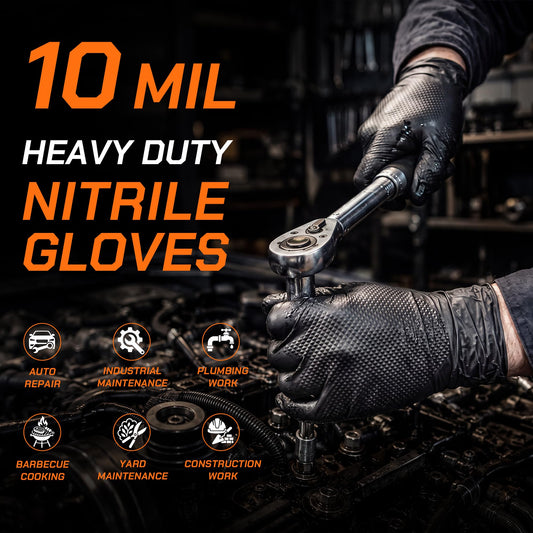
UYKKE 10 Mil Black Nitrile Gloves — 1000 Count
Regular price From $149.97 USDRegular price View on Amazon
-
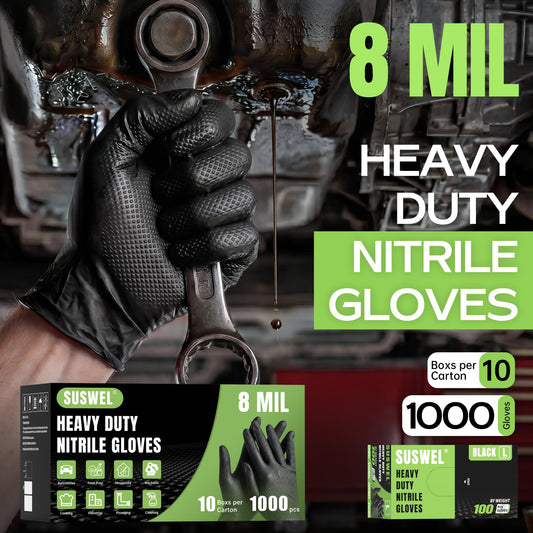
UYKKE SuSwel Series 8 Mil Black Nitrile Gloves — 1000 Count
Regular price From $124.96 USDRegular price -
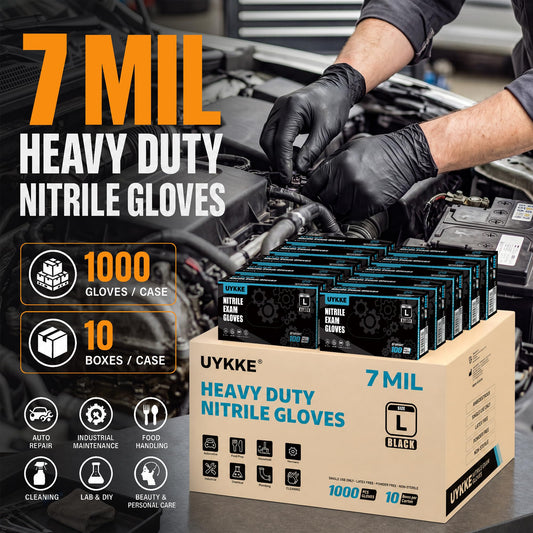
UYKKE 7 Mil Black Nitrile Gloves — 1000 Count
Regular price From $96.96 USDRegular price




Supply planning
Keep the right glove available at the right station.
Start with a simple monthly baseline: employees per shift × pairs per employee × operating days. Then add task changes, multiple shifts, seasonal peaks and reserve stock. Track usage by size and glove type, not only by total cases.
For facilities, assign approved glove specifications to task groups and forecast each separately. A one-SKU program is easy to order but may be wasteful for light assembly and unsuitable for chemical work.
Industry FAQ
Practical questions before you standardize a glove
How do I choose nitrile glove thickness for industrial work?
Choose from task duration, dexterity and observed mechanical wear. A 5–6 mil glove may suit assembly and inspection; 7–10 mil may suit longer dirty work. Thickness is not a chemical-resistance rating.
Are disposable nitrile gloves chemical resistant?
Resistance varies with the exact formulation, chemical, concentration, temperature and contact time. Use the SDS and glove-manufacturer compatibility data instead of relying on the material name alone.
Can one glove cover painting, maintenance and spill response?
Usually not. These tasks can involve very different hazards. A site should map approved glove specifications to defined tasks rather than issue one universal disposable glove.
Are disposable nitrile gloves safe around machinery?
Gloves can create an entanglement hazard around moving machinery. Follow guarding, lockout and site procedures and never use disposable nitrile as mechanical or electrical protection.
When is a reusable work glove more appropriate?
Sharp edges, heavy abrasion, lifting, impact, extended immersion or aggressive chemicals may require a reusable cut-, impact- or chemical-rated glove selected for that hazard.
What does raised texture add?
Texture can support grip on tools, oily parts and wet surfaces. It does not change the glove’s chemical compatibility or make a disposable glove cut- or heat-resistant.